

Two Moritella viscosa types that have historically been less prominent on the Scottish mainland — the so-called variant and a phenotypically distinct non-viscous classical form — are now being detected more frequently in areas where the classical strain has long dominated.

Photo credit (above): HIE/Gillian Frampton
Winter ulcers remain one of Scottish salmon farming’s most persistent cold-water challenges. The disease is most commonly associated with M. viscosa, which thrives at low sea temperatures. Infections can cause serious skin lesions and, in severe cases, may progress beyond the skin.
“The variant strain, which has historically been more of a problem in Shetland and Orkney, has been turning up increasingly on the Scottish mainland over the past couple of years,” says Michael Exton, Technical Manager, UK and Ireland at Pharmaq, part of Zoetis. “Alongside this, we’ve also recognised an increase in detections of a newer, phenotypically different non-viscous version of the classical M. viscosa, which also appears to be involved in lesion outbreaks.”
· Regional differences persist. Submissions to Pharmaq Analytiq indicate geographic variation in the types detected along the coast. The non-viscous classical form has dominated across regions, with the highest share in the south. Variant detections have been lower than in previous years overall, with the largest share recorded from mid-Norway, while classical detections remain the lowest but have shown some increase in the far north (Figure 1).
· A later peak can change risk windows. Sea temperatures fell later than usual, shifting the period of lowest temperatures and delaying the seasonal peak of winter-ulcer-associated bacteria. Instead of peaking in January or February, the season peaked in March, increasing the likelihood of overlap with periods of frequent handling.
· Field impressions and harvest data can move in the same direction. Several producers reported a lower winter ulcer burden than in previous seasons. Norwegian harvest statistics also show that the share of superior-grade salmon in the first quarter of 2026 was the highest recorded for a first quarter since 2019 (Norwegian Food Safety Authority).
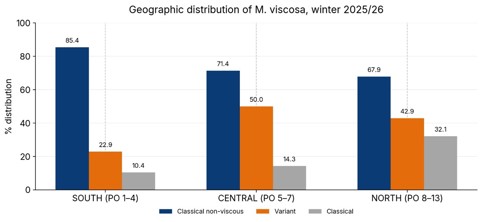
Figure 1: Geographic distribution of M. viscosa detections in submitted material during winter 2025/26. Classical non-viscous is most frequently detected in all regions and dominates in the south. Variant and classical account for a larger share in central and northern regions, illustrating geographic differences in the infection pattern observed in submitted material.
“We’ve also had detections of the bacteria later into the season than you would typically expect, most likely because water temperatures remained low later into the spring than usual,” Exton says.
A prolonged season matters operationally because it can overlap with the spring sea-lice period, when fish may be handled more frequently. “Handling puts stress on the skin and the mucus layer that protects fish against bacteria. That increases the risk of ulcer development while the winter-ulcer-associated bacteria are still present in the water,” says Hege Hellberg, veterinary pathologist at Pharmaq Analytiq.
Winter ulcer outbreaks often involve more than one bacterium at the same time. Tenacibaculum spp. and Aliivibrio wodanis are commonly detected alongside M. viscosa, and mixed infections can be frequent during parts of the season.
“Winter ulcers rarely have a single cause. Several bacteria are often found in the same outbreak, and to choose the most effective measures you need to see the full picture. PCR should be used alongside other methods, but it is not sufficient on its own,” Hellberg says.
Microbiological culture can complement PCR by providing a broader view of which types are dominant, whether they change over time, and whether new variants may be emerging.
“The positive signs from Norway show what systematic monitoring can achieve,” Exton concludes. “In Scotland, we’re working to build a clearer picture of how these bacteria interact across regions, and to turn that understanding into practical guidance that farmers can rely on.”
Head office/Production facilitySkogmo IndustriområdeIndustrivegen 50N-7863 Overhalla, NorwayTel:+47 74 28 08 00
PHQ.customer.service@zoetis.com


PHARMAQ is the global leader in vaccines and innovation for aquaculture and part of Zoetis, the world leader in animal health. The company provides environmentally sound, safe and efficacious health products to the global aquaculture industry through targeted research and the commitment of dedicated people. Production facilities, administration and research and development activities are based in Norway with subsidiaries in Chile, United Kingdom, Vietnam, Turkey, Spain, Panama and Hong Kong. PHARMAQ has approximately 300 employees. The company's products are marketed in Europe, North and South America, and Asia. For further information, visit the company's website at www.pharmaq.com. Privacy Policy. Cookie Policy. Terms of Use.
Copyright © 2020 Zoetis LLC. All rights reserved.